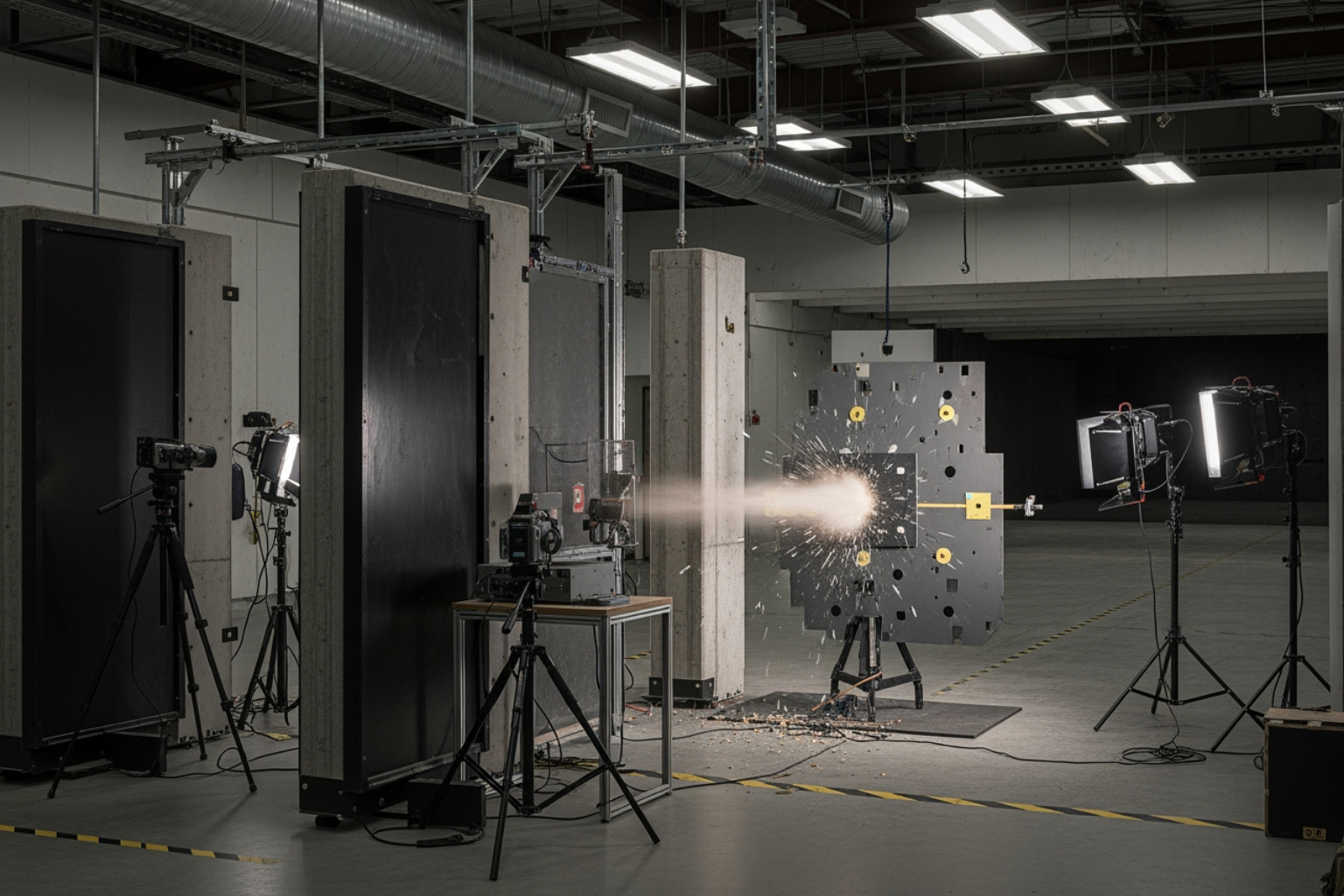
In the defense sector, the transition from a laboratory prototype to a fielded technology requires a rigorous iterative process. Ballistics testing services provide the critical empirical data necessary to refine material compositions, such as optimizing the ceramic-to-composite ratios in hard armor plates or the specific layering of high-performance polymers in transparent glazing systems. For engineers, this data is not merely a pass/fail metric; it is a diagnostic tool used to identify specific failure modes like delamination, spalling, or interlaminar shear failure under high-strain-rate loading.
Whether the program requires NIJ-compliant body armor certification, V50 ballistic limit testing for advanced armor plate, or blast resistance evaluation for architectural glazing, the selection of ballistics testing services is a critical path decision. Testing directly influences the survivability of personnel in high-threat environments. Labs like Element U.S. Space & Defense integrate firing ranges with environmental conditioning and advanced instrumentation. This integrated approach is vital for meeting program deadlines and securing government contracts, as it allows for coordinated environmental and ballistic qualification within a single test plan, ensuring that material degradation over time is accounted for in the final ballistic performance data.
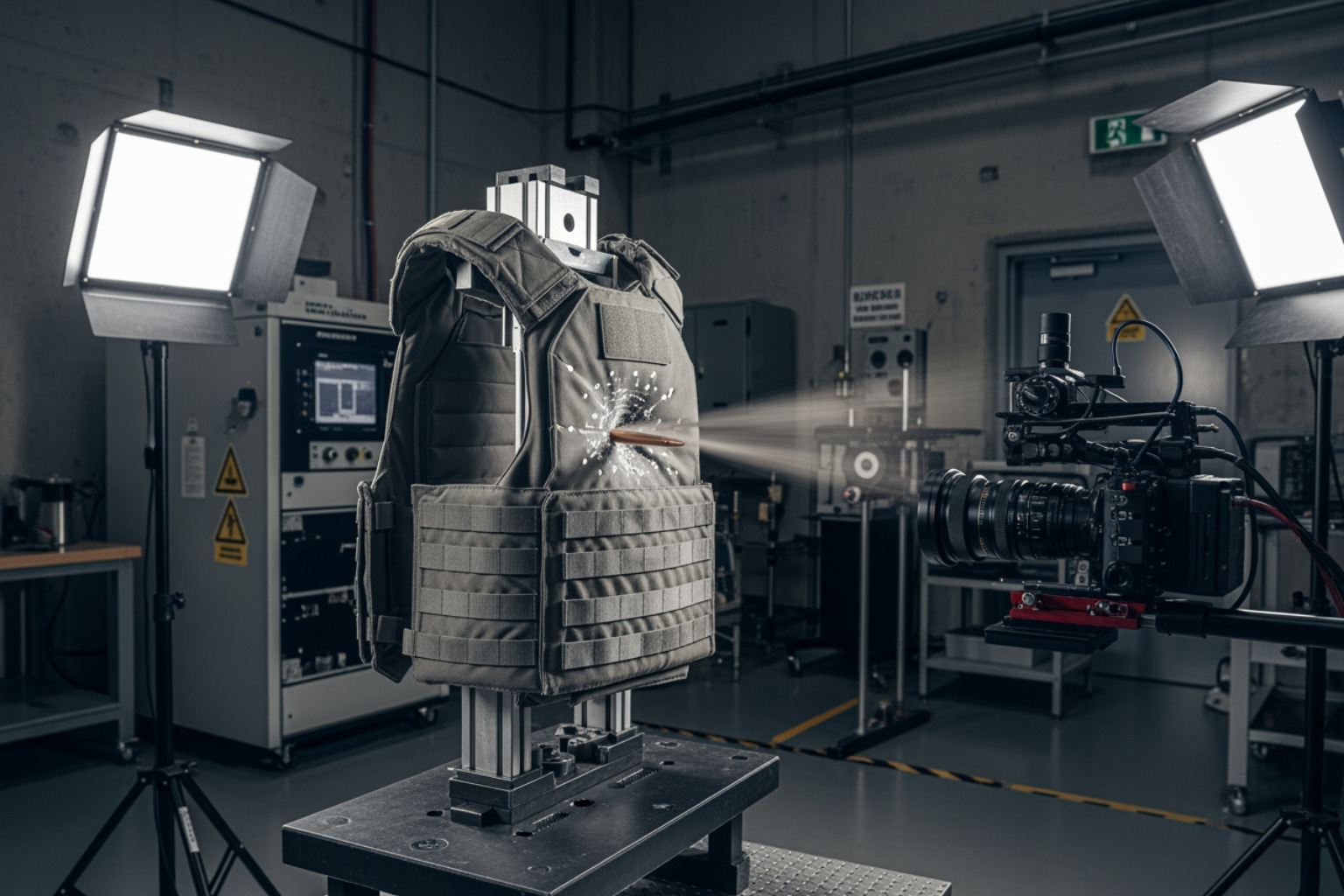
To ensure consistency across the defense industrial base, ballistics testing services operate under rigorous international and domestic standards. The National Institute of Justice (NIJ) standard for body armor is the most recognized framework. While many manufacturers currently rely on NIJ 0101.06, the industry is actively transitioning to NIJ 0101.07. This updated standard introduces more stringent testing protocols, including revised threat levels and more rigorous conditioning requirements for soft and hard armor.
A critical metric in these evaluations is the V50 Ballistic Limit, defined by MIL-STD-662F as the velocity at which a specific projectile has a 50% probability of penetrating the test sample. By firing a sequence of rounds at varying velocities—typically utilizing the "Up-and-Down" method—engineers can map the performance envelope of a material. This statistical approach is essential for characterizing armor performance against fragment-simulating projectiles (FSPs) and identifying the "Zone of Mixed Results" (ZMR), where both complete and partial penetrations occur. Furthermore, we measure back-face deformation (BFD) into a calibrated clay medium to ensure that even if a round is stopped, the transmitted energy—often referred to as Behind Armor Blunt Trauma (BABT)—does not exceed allowable limits. The rheological properties of the backing material, such as Roma Plastilina No. 1, are strictly controlled to ensure data repeatability.
For baseline definitions, available range capacities, and how Element executes NIJ and related programs, refer to the core service page: more info about ballistics testing.
Protective gear must defend against multi-threat environments. We provide specialized testing for stab and spike resistance under NIJ 0115.00, critical for correctional and patrol applications. Our facilities also conduct helmet impact and blunt trauma evaluations to support comprehensive cranial protection assessments. By utilizing standards like HOSDB 2017, we help manufacturers verify that helmets and vests mitigate the kinetic energy of impacts. Learn more info about body armor testing to see how we qualify first-responder gear.
Armored vehicles require a combination of opaque armor (high-hardness steel or ceramic composites) and transparent glazing. We test these components against direct fire and fragment impacts per STANAG 4569. For naval applications, we perform heavyweight shock testing per MIL-DTL-901E to support survivability in severe mechanical shock environments. Explore more info about munitions testing for adjacent ordnance and survivability capabilities.
The transition to NIJ 0101.07 replaces Level II and Level IIIA with HG1 and HG2 (Handgun), while rifle protection levels move toward RF1, RF2, and RF3. This update better aligns testing with modern ammunition threats and standardizes reporting. Manufacturers must register via the Testing Information Management System (TIMS) to list products on the new Compliance Product List (CPL).
Technical excellence in ballistics testing services is defined by accreditation and precision. Element U.S. Space & Defense maintains ISO 17025 and NVLAP (Lab Code 200818-0) accreditations, supporting data integrity for procurement and quality systems. Our facilities, such as the National Ordnance and Ballistic Test Center in Camden, AR, are ITAR compliant and secured for sensitive government projects. For details on range assets and site capabilities, see more info about Camden facilities.
Modern ballistics labs utilize high-fidelity instrumentation to capture the physics of an impact event. This data is critical for validating finite element analysis (FEA) models used in armor design:
For more on the physics and measurement concepts behind projectile velocity characterization, see scientific research on velocity decay measurements.
Materials perform differently under extreme thermal and climatic stress. We subject samples to extreme temperature, humidity, salt fog, and sand/dust exposure prior to ballistics testing services events. This conditioning, aligned to MIL-STD-810, helps evaluate whether armor systems degrade across storage and operational environments. For instance, moisture ingress can significantly reduce the interlaminar shear strength of aramid-based composites. You can find more info about environmental testing regarding these stressors here.
Safety in public buildings and high-value assets requires protection against explosive threats. We conduct arena testing and shock tube evaluations to assess glazing performance and structural integrity. Our active shooter simulations (ASTM F3561) include weakening a system with ballistic rounds before attempting physical breaches, providing a realistic assessment of security hardware under combined stress.
To learn how Element U.S. Space & Defense can support your ballistics testing services and armor qualification requirements, contact our team today.


Accessibility: If you are vision-impaired or have some other impairment covered by the Americans with Disabilities Act or a similar law, and you wish to discuss potential accommodations related to using this website, please contact us at (833) 673-8773