Element U.S. Space & Defense performs MIL-DTL-901 shock testing, a naval qualification process that evaluates whether shipboard equipment can remain functional after severe shock loading. When qualifying systems for maritime defense programs, physical verification confirms that hardware can withstand severe shock pulses transmitted across a vessel hull. Meeting these qualification milestones ensures operational readiness before deployment on fleet vessels.
Contract specifications set the parameters and pass criteria, so that program managers are able to confirm qualification requirements early in order to avoid testing delays and redesign cycles. Standard records remain accessible through the Department of Defense (DoD) ASSIST database. Early review also clarifies the documentation that is needed for test readiness and the final program record.
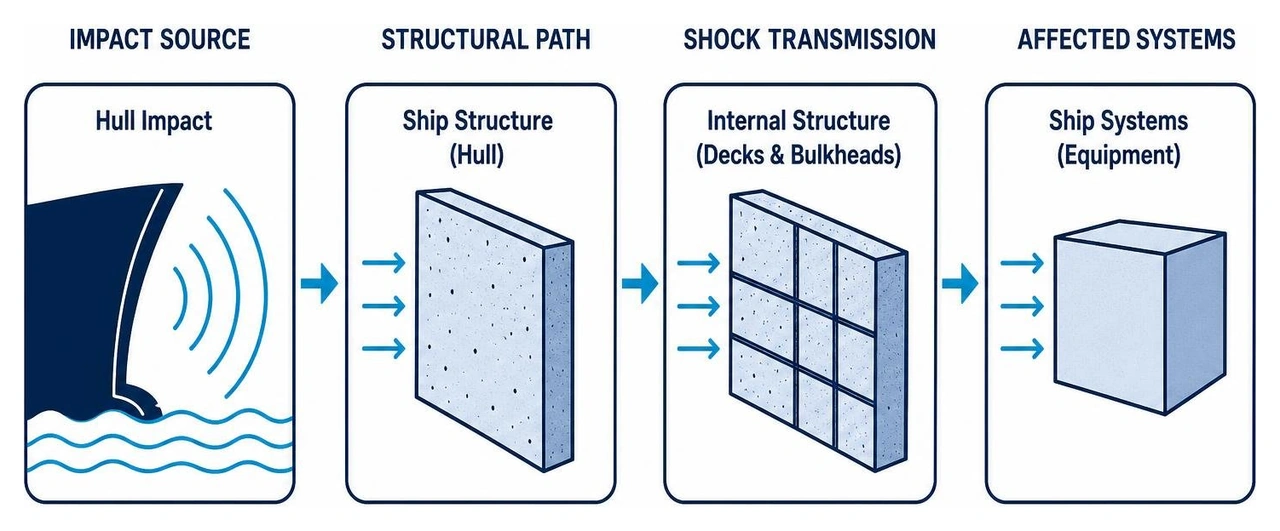
Element U.S. Space & Defense evaluates how shipboard hardware responds to severe mechanical shock associated with underwater weapon detonations. Structural stiffness, damping, and interface load paths influence survivability during transient pulses.
The MIL-DTL-901E specification evaluates whether mission-critical shipboard equipment retains structural integrity and required function after a naval shock event. Naval Sea Systems Command (NAVSEA) establishes technical baselines for principal units, subsidiary components, and subassemblies on naval vessels.
Engineers categorize naval hardware using core specification parameters, and Element U.S. Space & Defense applies these categories during comprehensive test planning:
Element U.S. Space & Defense provides specialized shock testing services that align test planning with naval procurement requirements. That planning can identify fixture, instrumentation, and post-test inspection needs before the laboratory schedule is finalized for the program.
The test apparatus is selected based on the equipment mass and mounting requirements. Appropriate floating shock platforms help replicate the mechanical loading expected at the shipboard installation.
Class I covers rigid mounting, Class II addresses resilient mounting with shock isolators, and Class III applies where both configurations are approved.
Naval shock qualification is distinguished from general environmental testing because naval combat shock involves severe hull-transmitted impacts. MIL-STD-810 addresses broader environmental exposures, while the procurement specification determines the applicable naval qualification profile.
Element U.S. Space & Defense distinguishes shock from steady-state vibration procedures such as MIL-STD-167, which address continuous cyclic excitation rather than isolated transient impacts. Defense qualification services can be planned around the contract flow-down.
Element U.S. Space & Defense conducts full qualification programs at its Naval Systems & Heavyweight Shock facility in Rustburg, Virginia. Engineering teams coordinate test plan approval, custom dynamic fixturing, precision instrumentation layout, dynamic data collection, and post-shock physical inspections under one secure roof. Program managers benefit from direct communication with test engineers throughout the qualification lifecycle.
For MIL-DTL-901 shock testing support, contact Element U.S. Space & Defense to discuss the qualification requirements your program must prove.
Element U.S. Space & Defense answers common technical questions regarding shock qualification protocols, fixture designs, and governing naval standards.
Element U.S. Space & Defense determines the setup from total equipment weight, mounting classification, and test item boundaries. At Rustburg, Virginia, custom fixtures replicate installation stiffness, and the team confirms the test approach against the procurement requirements before execution begins.
The contract governs the applicable revision, while current records are available through the Department of Defense ASSIST database for reference during planning.
Element U.S. Space & Defense performs post-test visual examinations, dimensional checks, and functional checks after dynamic impact trials. The resulting record compares structural findings and component operation with the customer’s pass criteria, supporting a clear qualification decision for the program.
Element U.S. Space & Defense maintains relevant accreditation scope for its qualification facilities. Program managers can review current details on the official accreditations page before finalizing procedures, then confirm that scope aligns with contract requirements for the program.


Accessibility: If you are vision-impaired or have some other impairment covered by the Americans with Disabilities Act or a similar law, and you wish to discuss potential accommodations related to using this website, please contact us at (833) 673-8773